Small and Medium-sized Enterprises (SMEs) are a critical pillar of the Canadian economy, representing over 98% of all employer businesses. As foundational agents of employment generation, innovation, and sustainable growth, SMEs in Canada contribute significantly to GDP and regional economic development. This blogpost explores the structure, definition, and regional distribution of SMEs across Canada, highlights key challenges and examines the growing role of Canadian SMEs in driving reverse innovation.
What is an SME in Canada?
SMEs make a significant component of Canadian economy and constitute a frequent foundation structure for innovation and sustainability initiatives. According to Innovation, Science and Economic Development Canada (ISED, 2023), SMEs represent
- over 98% of all employer businesses,
- employing approximately 1.07 million individuals and
- contributing to about half of the national GDP.
It goes without saying, hence, that Canadian SMEs hold powerful strategic importance not only as economic agents for employment generation, but also as mechanisms for systemic transformation.
In the context of reverse innovation, a process wherein innovations in resource-constrained economies are adopted and/ or adapted in more developed economic environments, SMEs provide the agility, localized decision-making capacity, and entrepreneurial openness essential to test unconventional or grassroots-originated solutions. The rising momentum of sustainable growth imperatives, particularly in the post-COVID recovery era, renders SMEs especially relevant in Canada’s national and regional innovation ecosystems.
Definition and Classification
As defined in ISED framework, in Canada, the term SME typically encompasses businesses with fewer than 500 employees. These are further disaggregated in Table 1.
Table 1. Classification of Canadian SMEs
| Category | No. of paid employees |
| Micro enterprises | 1–4 |
| Small enterprises | 5–99 |
| Medium enterprises | 100–499 |
| SMEs | 1 – 499 |
Source: Key Small Business Statistics 2024, Innovation, Science and Economic Development Canada, Government of Canada
Regional Distribution and Sectoral Strengths of Canadian SMEs
Canada does not have a monolithic SME ecosystem and its regional distribution exhibits diverse outlines of industrial prowess and innovation capability:
- Ontario and Quebec lead in aggregate SME numbers due to urbanization, population density, and diversified manufacturing and service sectors.
- British Columbia reflects a higher SME density per capita, supported by a dynamic startup ecosystem, digital innovation hubs, and propinquity to the Asia-Pacific trade corridor.
- The Prairies, particularly Alberta and Saskatchewan, are characterized with SMEs aligned with agriculture, construction, and energy.
- Atlantic Canada reveals a formidable existence of SMEs in traditional industries such as fisheries, forestry, and tourism, a good of which are currently delving in sustainability-driven practices.
Figure 1. Regional and Sectoral Characteristics of Canadian SMEs
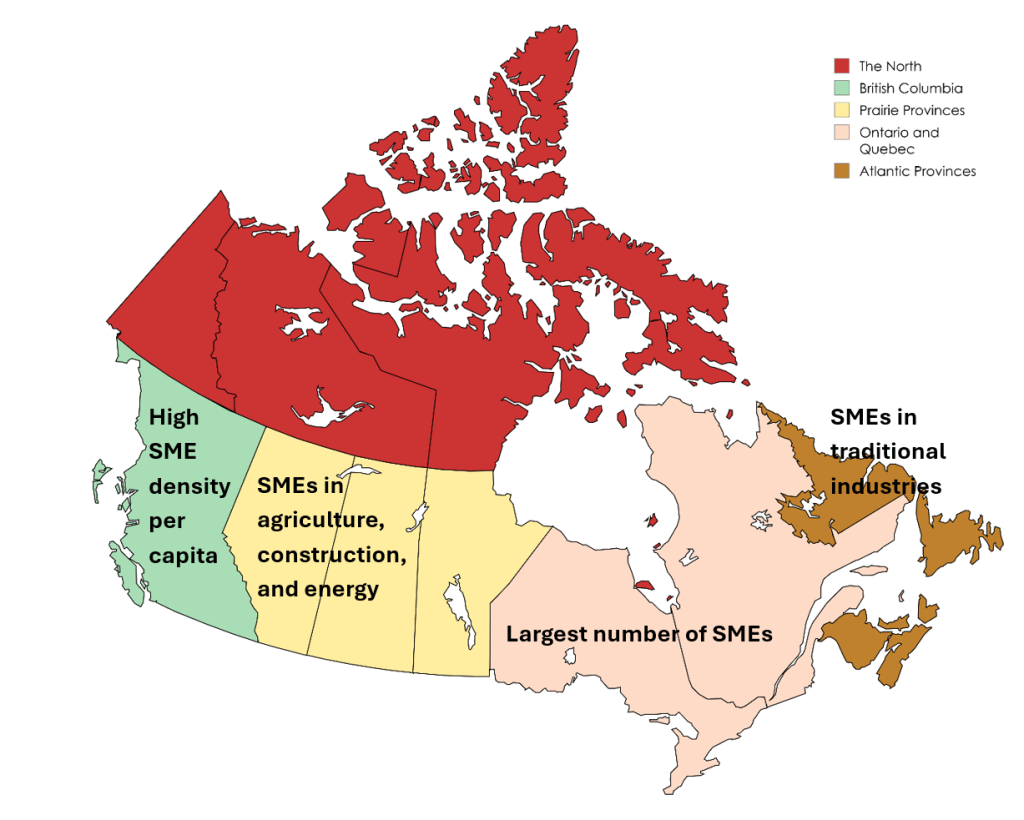
Developed on the basis of Key Small Business Statistics from Nov 2019 to 2024, Innovation, Science and Economic Development Canada, Govt. of Canada.
This heterogeneity stipulates an abundant landscape for analyzing how reverse innovation manifests differently across sectors and regions.
Challenges Facing Canadian SMEs: Innovation and Capacity Barriers
Despite participating increasingly in digital and green innovation, Canadian SMEs continue facing resource and capacity constraints. The Statistics Canada Survey of Digital Technology and Internet Use, 2024 revealed that several digitalization indicators have stabilized or declined in Canadian SMEs since 2021. This lack of strategic digital direction and innovation is particularly concerning among the challenges such as access to finance, labour shortages, and limited global market exposure inhibit many SMEs from scaling innovation (CFIB, 2024). As per the Report of the Standing Committee on Industry and Technology presented in House of Commons, Canada in March 2023, “rising prices, supply chain challenges, increasing government costs, labour shortages, lack of predictability of the economic recovery, debt, issues related to supply chain disruptions, and the sudden rise in input costs partially triggered by the war in Ukraine” are the biggest challenges faced by Canadian SMEs.
The Role of Canadian SMEs in Reverse Innovation and Sustainability
Given the structural embeddedness of SMEs in the Canadian economy, understanding their distribution, capabilities, and constraints is crucial for analysing the feasibility and diffusion of reverse innovation. As reverse innovation seeks to disrupt conventional value chains by integrating bottom-up knowledge and low-cost innovation paradigms, Canadian SMEs are uniquely positioned to act as implementation laboratories for adapting such innovations to developed market contexts.
Moreover, as Canada intensifies its focus on net-zero goals, circular economy frameworks, and inclusive regional development, SMEs will increasingly serve as both beneficiaries and enablers of sustainable innovation models, including those influenced by experiences and practices from the Global South.
References
- Canadian Federation for Independent Businesses. (2024). https://competition-bureau.canada.ca/sites/default/files/documents/Canadian-Federation-of-Independent-Business–2024-07-10–SME-priorities-and-comments-on-AI.pdf
- Innovation, Science and Economic Development Canada (2024). Key Small Business Statistics – 2024. https://ised-isde.canada.ca/site/sme-research-statistics/en/key-small-business-statistics/key-small-business-statistics-2024
- Innovation, Science and Economic Development Canada (2024). Key Small Business Statistics – 2023. https://ised-isde.canada.ca/site/sme-research-statistics/en/key-small-business-statistics/key-small-business-statistics-2023
- Innovation, Science and Economic Development Canada (2024). Key Small Business Statistics – 2022. https://ised-isde.canada.ca/site/sme-research-statistics/en/key-small-business-statistics/key-small-business-statistics-2022
- Innovation, Science and Economic Development Canada (2024). Key Small Business Statistics – 2021. https://ised-isde.canada.ca/site/sme-research-statistics/en/key-small-business-statistics/key-small-business-statistics-2021
- Innovation, Science and Economic Development Canada (2024). Key Small Business Statistics – 2020 Edition. https://ised-isde.canada.ca/site/sme-research-statistics/en/key-small-business-statistics/key-small-business-statistics-2020
- Innovation, Science and Economic Development Canada (2024). Key Small Business Statistics – November 2019. https://ised-isde.canada.ca/site/sme-research-statistics/en/key-small-business-statistics-november-2019
- Lightbound, J. Report of the Standing Committee on Industry and Technology. (March, 2023). Hoyse of Commons. SMALL AND MEDIUM ENTERPRISES IN CANADA: CHARTING A COMPETITIVE FUTURE. Report of the Standing Committee on Industry and Technology. https://www.ourcommons.ca/content/Committee/441/INDU/Reports/RP12266977/441_INDU_Rpt10_PDF/441_INDU_Rpt10-e.pdf
- Nigam, S. (2025). The Emerging Impact of Reverse Innovation among Canadian SMEs in Driving Economic and Sustainable Growth (Research in progress).
- Statistics Canada (2024). https://www150.statcan.gc.ca/n1/daily-quotidien/240917/dq240917c-eng.htm


 Shailly Nigam
Leave a reply to Post #12 – The Canadian Policy Backdrop for SME Innovation – Shailly Nigam Cancel reply