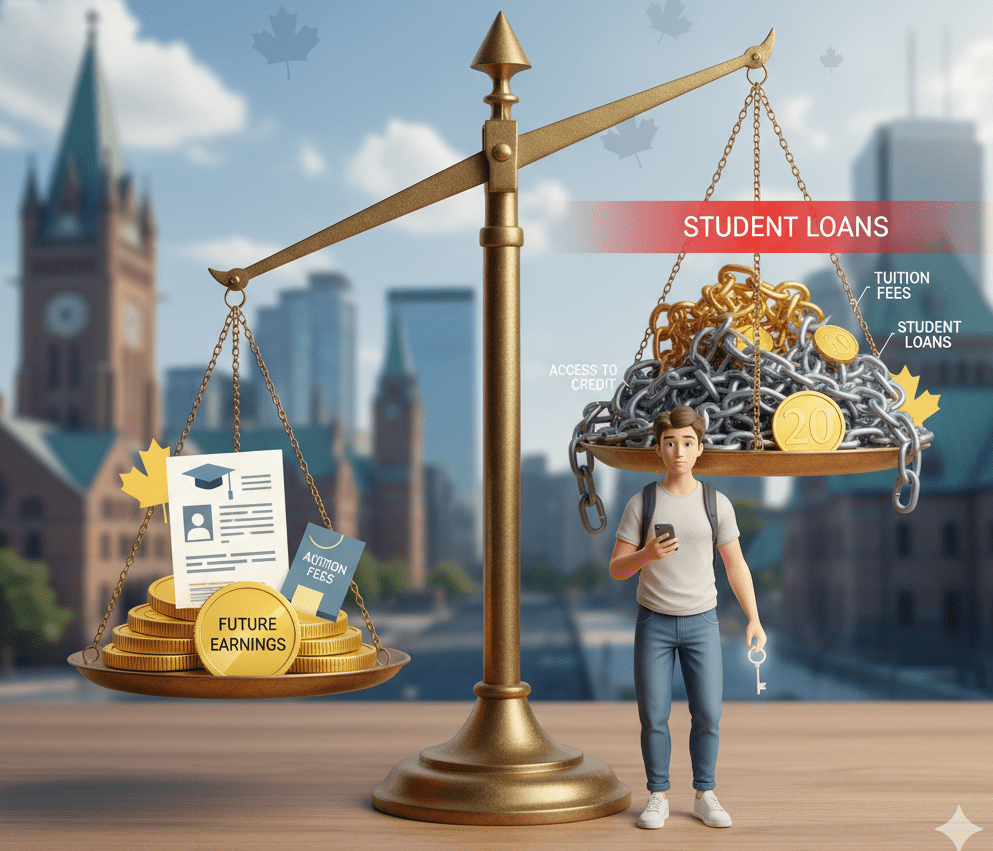
Source: The above image is for decorative purposes only and has been created using Google Nano Banana on Jan 5, 2026
To begin, this post is an exploratory draft section of my ongoing research project and not a completed academic manuscript.
Student debt in Canada has become a defining feature of the postsecondary system. Over the past month, I have been engaged in the early stages of an empirical research project examining how financial incentives and constraints shape educational investment decisions in Canada. I have been developing this project with the aim of systematically examining how household income, access to student loans, and student debt at graduation influence postsecondary participation, completion, and early labour market outcomes.
The motivation for this study arises from both gaps in the existing literature and sustained observation within postsecondary education. While student debt has become a prominent feature of Canada’s higher education system, much of the policy and public discourse remains focused on repayment structures and aggregate debt levels and comparatively less attention has been paid to how financial conditions affect educational choices at earlier stages, or to how debt exposure interacts with labour market outcomes following graduation. These omissions are particularly consequential in a system characterized by substantial provincial variation in tuition, financial aid, and repayment policies.
My current research approaches education as an investment decision made under constraint. Drawing on human capital theory and models of intertemporal choice, it conceptualizes postsecondary participation as the outcome of individuals weighing expected lifetime returns against current costs under imperfect credit markets. From this perspective, student loans may relax borrowing constraints, but they may also alter educational choices and post-graduation behaviour through debt exposure.
The empirical analysis relies exclusively on Canadian data sources, including the National Graduate Survey, the Canadian Income Survey, and Statistics Canada education indicators. These datasets allow for the joint examination of pre-education financial conditions, postsecondary outcomes, and early career labour market performance. The study tests two central hypotheses:
- first, that individuals from lower-income households or with limited access to credit are less likely to pursue or complete postsecondary education; and
- second, that higher levels of student debt at graduation are associated with weaker early career outcomes.
I plan to write a small blog series intended to document the conceptual development, empirical strategy, and emerging findings of the project. Upcoming posts will address the theoretical framework, situate the study within existing literature, outline data and model choices, and discuss the policy implications of the results for student aid and educational access in Canada.
By adopting an explicitly empirical approach, this research aims to contribute to the Education Economics literature by clarifying how financial incentives and constraints influence educational investment and labour market outcomes in a Canadian institutional setting.
References
Choi, S.-K., & Hur, H. (2025). Student Debt Loans and Labor Market Outcomes: A Lesson in Unintended Consequences. Journal of Applied Business and Economics, 27(2). https://doi.org/10.33423/jabe.v27i2.7585
Lochner, L., Liu, Q., & Gervais, M. (2021). Return on student loans in Canada (NBER Working Paper No. 29130). National Bureau of Economic Research. https://doi.org/10.3386/w29130
Lochner, Lance, Todd Stinebrickner, and Utku Suleymanoglu. 2021. “Parental Support, Savings, and Student Loan Repayment.” American Economic Journal: Economic Policy 13 (1): 329–71. doi: 10.1257/pol.20180401
Lochner, L., & Monge‑Naranjo, A. (Sep, 2012). Credit constraints in education. Annual Review of Economics. https://doi.org/10.1146/annurev-economics-080511-110920
Milian, R. P., Zarifa, D., & Seward, B. (2021). Paying back student loans: Demographic, human capital and other correlates of default and repayment difficulty. Higher Education Quarterly, 77–97. https://crdcn.ca/publication/paying-back-student-loans-demographic-human-capital-and-other-correlates-of-default-and-repayment-difficulty/
Neill, C. M. (n.d.). The effect of student loan limits on university enrolments. Canadian Research Data Centre Network. https://crdcn.ca/publication/the-effect-of-student-loan-limits-on-university-enrolments/
Nigam, S. (2026). Incentives, Constraints, and Choice: An Empirical Analysis of Student Debt and Educational Investment in Canada (Research in progress).
Walters, D., Brown, R., Parekh, G., Einmann, T., & Bader, D. (n.d.). Student loan outcomes of Ontario transfer students: Evidence based on PSIS‑CSLP data linkages. Canadian Research Data Centre Network. https://crdcn.ca/publication/student-loan-outcomes-of-ontario-transfer-students-evidenced-based-on-psis-cslp-data-linkages/


Leave a Reply