This post marks a beginning of a new category in blog. I am currently pursuing Master of Education (MEd) as a part of which, I’ve been exploring how curriculum theory has evolved over the last century. One of the most powerful realizations is how dramatically ideas about teaching and learning have shifted from rigid, teacher-centered approaches to more flexible, learner-centered models. To bring this transformation to life, I created the following three-panel comic using Comic Life 3.
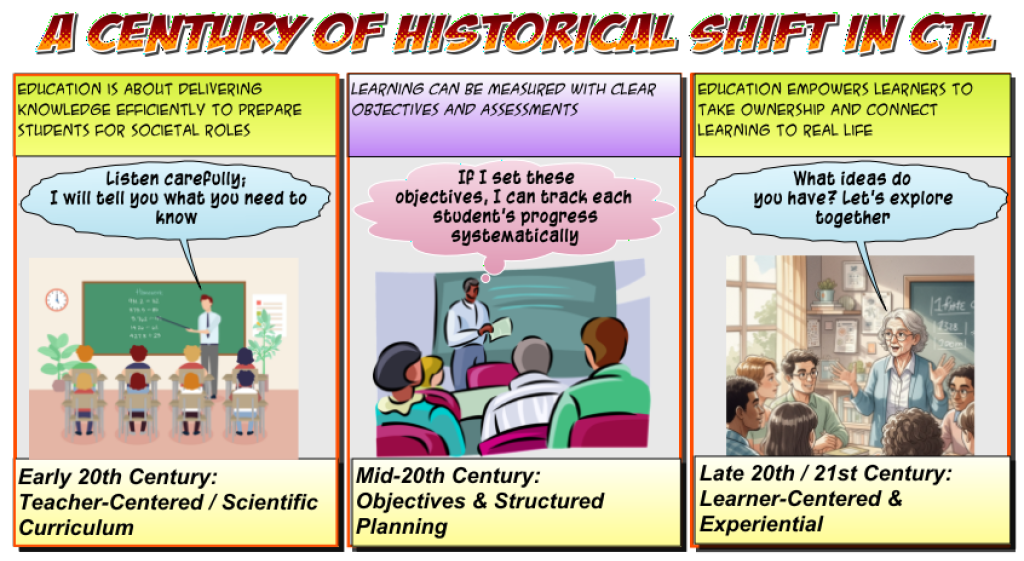
I have noticed that the biggest shifts in curriculum theory over the past century move from rigid, teacher-centered models focused on standardized outcomes to learner-centered approaches that value experience, diversity, and critical engagement. A little discussion follows.
From Efficiency to Objectives
Early in the 20th century, John Bobbitt (1918/2022) described education as a scientific process focused on efficiency and preparing students for societal roles. By the mid-century, Ralph Tyler (1949/2022) emphasized measurable objectives helpful for structure but sometimes reducing learning to checklists.
From Reflection to Empowerment
Later, John Dewey (1929/2022) and Paulo Freire (1970/2022) reframed curriculum as experiential, reflective, and liberatory. Today, scholarship emphasizes integrating Indigenous knowledge, moving beyond Eurocentric traditions (Lamb & Godlewska, 2021).
Why It Matters for My Learning
Studying these shifts in my MEd is helping me see curriculum as dynamic, not fixed. The move toward learner-centered and inclusive education resonates deeply with how I view my own teaching and learning valuing critical thinking, cultural responsiveness, and lifelong learning.
References:
- Bobbitt, J. F. (1918/2022). Scientific method in curriculum-making. In D. J. Flinders & S. J. Thornton (Eds.), The curriculum studies reader (6th ed., pp. 11–18). Routledge.
- Comic Life 3 for Mac & Windows | plasq.com. (n.d.). Plasq.com. https://plasq.com/apps/comiclife/macwin/
- Tyler, R. W. (1949/2022). Basic principles of curriculum and instruction. In D. J. Flinders & S. J. Thornton (Eds.), The curriculum studies reader (6th ed., pp. 60–68). Routledge.
- Freire, P. (1970/2022). The adult literacy process as cultural action for freedom. In D. J. Flinders & S. J. Thornton (Eds.), The curriculum studies reader (6th ed., pp. 286–302). Routledge.
- Dewey, J. (1929/2022). My pedagogic creed. In D. J. Flinders & S. J. Thornton (Eds.), The curriculum studies reader (6th ed., pp. 22–28). Routledge.


Leave a Reply