The conventional model of innovation transfer, from high-income countries to the developing world, is no longer universally dominant. Solutions developed in the Global South, often designed to address resource scarcity and social inclusion, are now being adopted in advanced economies through the process called reverse innovation. For Canada, its multicultural ecosystem offers valuable pathways for post-pandemic recovery, sustainable development, and progress toward key UN Sustainable Development Goals (SDGs).
This post explores the mechanism by which reverse innovation reaches Canada and becomes embedded into its innovation landscape.
Reverse Innovation’s Trajectory –
Reverse innovation follows a multi-directional, often non-linear process. Innovations developed for low-resource, high-constraint environments (such as India, Kenya, or Bangladesh) are increasingly entering advanced economies due to their
- Affordability
- Resilience
- Social inclusivity
Frugal diagnostic tools, off-grid energy systems, mobile banking platforms, and low-cost agricultural implements are some prominent examples. These solutions align with Canada’s growing need for:
- Sustainability
- Cost-efficiency
- Inclusive service delivery
Channels of Reverse Innovation Flow into Canada
The flow of innovation from the Global South to Canada happens through several channels:
- Diaspora Networks: Immigrant entrepreneurs bring ideas from their home countries and contextualize them for Canadian markets (Kshetri, 2020).
- Global Research Partnerships: Canadian universities collaborate with institutions in the Global South on healthcare, clean energy, and community finance innovations.
- Development Agencies and Incubators: Organizations like MaRS and Grand Challenges Canada support global south-origin innovations and bring them to Canada via impact accelerators.
- Digital Knowledge Exchange: Open-access platforms and South-North webinars have enabled quicker diffusion of tested innovations.
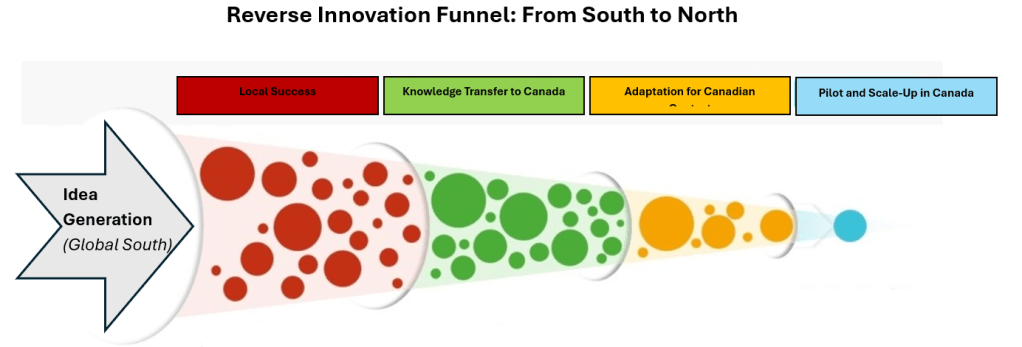
Figure 1 illustrates the process of Reverse Innovation into Canada.
Figure 1. Reverse Innovation Funnel
Most frequent types of reverse innovations
Innovation is not just about tech products. Often, process and service innovations prove more scalable:
- Healthcare: Mobile diagnostic kits from India are adapted in Indigenous communities in Nunavut.
- Energy: Off-grid solar tech from Kenya now powers small farms and food trucks in Ontario.
- Finance: Group lending and peer-to-peer saving models from Bangladesh are trialed in immigrant-dense communities in Toronto and Vancouver.
These innovations are often cheaper, more community-centered, and resilient, ideal for addressing regional disparities in Canada.
Challenges to Adoption
Reverse innovation’s journey into Canada is not frictionless. Key obstacles include:
- Cultural and Perception Barriers: There’s often skepticism around adopting “Southern” innovations in a “Northern” context.
- Regulatory Misalignment: Health and safety regulations, insurance requirements, and certification demands in Canada can stifle direct adaptation.
- Scaling Limitations: Many promising pilots lack the infrastructure or capital to scale across regions.
Policymakers and incubators must create bridging mechanisms such as reverse innovation vouchers, immigrant entrepreneur funding, and inclusive procurement mandates to accelerate adoption. As Canada advances its SDG commitments, especially Goal 9 (Industry & Innovation) and Goal 17 (Global Partnerships), reverse innovation offers a practical, inclusive, and transformative path forward.
References
- Government of Canada, Statistics Canada. (2021, September 22). Immigrant and second-generation entrepreneurs in Canada: An intergenerational comparison of business ownership. https://www150.statcan.gc.ca/n1/pub/36-28-0001/2021009/article/00003-eng.htm.
- Govindarajan, Vijay & Ramamurti, Ravi. (2011). Reverse innovation, emerging markets, and global strategy. Global Strategy Journal. 1. 191 – 205. 10.1002/gsj.23.
- Hashmi, H.B.A., Ooms, W., Voinea, C.L. and Caniëls, M.C.J. (2025), “Reverse innovations bridging the gap between entrepreneurial orientation and international performance”, International Journal of Emerging Markets, Vol. 20 No. 13, pp. 30-54. https://doi.org/10.1108/IJOEM-08-2021-1178
- Innovation, Science and Economic Development Canada (2024). Key Small Business Statistics – 2023. https://ised-isde.canada.ca/site/sme-research-statistics/en/key-small-business-statistics/key-small-business-statistics-2023
- Nigam, S. (2025). The Emerging Impact of Reverse Innovation among Canadian SMEs in Driving Economic and Sustainable Growth (Research in progress).
- OECD (2023), OECD Economic Surveys: Canada 2023, OECD Publishing, Paris, https://doi.org/10.1787/7eb16f83-en.
- Ramamurti, Ravi. (2012). What Is Really Different about Emerging Market Multinationals?. Global Strategy Journal. 2. 10.1002/gsj.1025.
- Zhang, Zhen & Chun, Douglas. (2017). Becoming entrepreneurs: How immigrants developed entrepreneurial identities. International Journal of Entrepreneurial Behavior & Research. 24. 10.1108/IJEBR-07-2016-0214.

 Shailly Nigam
Leave a comment