So we know that Reverse innovation refers to innovations developed in emerging markets that are later adapted for advanced economies. While these innovations are often celebrated for their resourcefulness and frugality, many struggle to scale successfully when transferred to countries like Canada. By examining these challenges, Canadian SMEs can gain critical insights to improve adaptation strategies and enhance their innovation outcomes.
Why Some Reverse Innovations Fail to Scale in Canada
Innovations developed in emerging markets face unique obstacles when introduced in advanced economies:
- Regulatory Barriers – Innovations tailored to lightly regulated environments often encounter strict compliance and certification requirements in Canada.
- Cultural Misalignment – Products designed for communal or low-income contexts may not resonate with Canadian consumer expectations.
- Market Structure Differences – Distribution channels, financing mechanisms, and consumer behaviors differ significantly between emerging and advanced markets.
- Intellectual Property and Standards – Emerging-market solutions may lack formal IP protections or quality certifications required for Canadian adoption.
Lessons for Canadian SMEs from Reverse Innovation Struggles
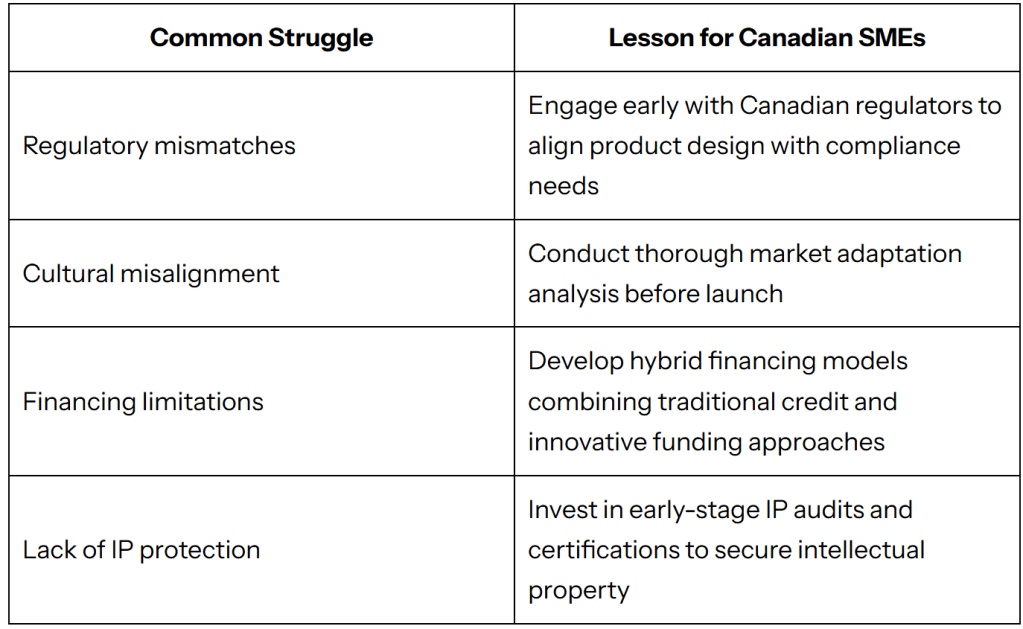
Understanding why reverse innovations fail abroad can guide Canadian SMEs to better anticipate and mitigate these challenges. Table 1 shows a list of some general struggles and discusses plan of action for Canadian SMEs.
Table 1. Lessons for Canadian SMEs from Reverse Innovation Struggles
Applying a Canadian Lens to Reverse Innovation
Canada’s multicultural population and robust institutional framework provide opportunities to adapt reverse innovations effectively. For instance, frugal healthcare devices developed in India or Africa can be integrated into Canada’s public-private healthcare partnerships. Renewable microgrid solutions designed for rural communities abroad may inspire localized clean energy projects in Canada’s northern regions and failures in scaling reverse innovations are not setbacks but opportunities for learning. By studying these challenges, Canadian SMEs can convert lessons from emerging markets into actionable strategies that strengthen their innovation capacity, resilience, and global competitiveness.
References :
References
- Ahuja, S. & Sadreddin, A. (2023). Frugal digital innovation: delivering healthcare services in rural India. Elgar Online. https://www.elgaronline.com/edcollchap/book/9781800888807/book-part-9781800888807-13.xml
- Biondi, V., Iraldo, F., & Meredith, S. (2002). Achieving sustainability through environmental innovation: the role of SMEs. International Journal of Technology Management, 24(5/6), 612. https://doi.org/10.1504/ijtm.2002.003074
- Govindarajan, V., & Ramamurti, R. (2011). Reverse innovation, emerging markets, and global strategy. Global Strategy Journal, 1(3–4), 191–205. https://doi.org/10.1002/gsj.23
- Nigam, S. (2025). The Emerging Impact of Reverse Innovation among Canadian SMEs in Driving Economic and Sustainable Growth (Research in progress).
- OECD (2019), OECD SME and Entrepreneurship Outlook 2019, OECD Publishing, Paris, https://doi.org/10.1787/34907e9c-en.
- Prahalad, C. K. (2005). The Fortune at the Bottom of the Pyramid. Wharton School Publishing. https://knowledge.wharton.upenn.edu/article/the-fortune-at-the-bottom-of-the-pyramid-eradicating-poverty-through-profits/
- United Nations. (2015). Transforming our world: The 2030 Agenda for Sustainable Development. United Nations.
- World Bank. (2020). Innovation for Development: Strategic Priorities. World Bank Publications.


Leave a Reply