Reverse innovation, once considered a fringe strategy, is now gaining traction as a potent force reshaping innovation ecosystems in developed economies. In earlier posts on this blog, we traced its trajectory into Canadian SMEs and discussed the strategic, cultural, and operational implications. In this post, we widen the lens to examine reverse innovation through three analytical strata: developmental, microeconomic, and macroeconomic.
Developmental Lens: Reframing the Innovation Hierarchy
The traditional model of innovation posits a unidirectional flow: from Global North to South. Reverse innovation upends this notion, suggesting that development is not just a matter of catching up, but of contributing forward. This lens reveals three critical shifts:
- Agency in the Global South: Innovations in resource-constrained environments, like frugal medical devices or community-led fintech models, are not “cheap knock-offs,” but products of deep contextual intelligence.
- Development as Dialogue: Development is no longer about diffusion alone but co-evolution as Southern innovations are recontextualized in Northern SMEs, development becomes mutual and iterative.
- SDG Alignment: Reverse innovations often carry embedded sustainability principles (e.g., energy efficiency, circularity), making them naturally aligned with Canada’s commitments to the UN Sustainable Development Goals (SDGs).
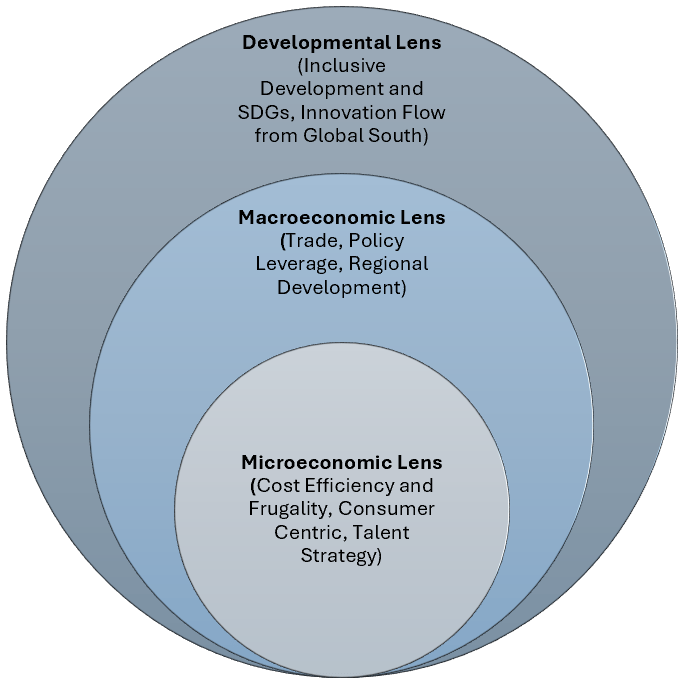
To better visualize the interconnected influence of reverse innovation, the following diagram presents a Three-Lens View highlighting how developmental, microeconomic, and macroeconomic perspectives converge to shape its impact on Canadian SMEs.
Figure 1. Three-Lens View of Reverse Innovation Impact
In this sense, reverse innovation is not only an economic input it is a developmental ethic.
Microeconomic Lens: Rethinking Firm Behavior in Canadian SMEs
Canadian SMEs, particularly those in sectors such as healthtech, agri-innovation, and education, are beginning to adopt and adapt reverse innovations. From a microeconomic perspective, this shift carries several implications:
- Cost Structures: Reverse innovation introduces frugality not as a compromise, but as a competitive advantage. SMEs can lower production and operating costs without sacrificing quality.
- Consumer Preferences: Many reverse innovations are born in settings with demanding constraints like low literacy, low bandwidth, or low income which make them especially relevant to underserved and rural Canadian populations, including Indigenous and immigrant communities.
- Firm Strategy and Innovation Orientation: Reverse innovation encourages explorative innovation behavior. SMEs that might lack large R&D budgets can pivot toward scouting globally, adapting locally leveraging knowledge transfers rather than starting from scratch.
- Labor and Human Capital: Reverse innovations often require interdisciplinary problem-solving, increasing demand for T-shaped professionals and multicultural competencies within SME teams.
This reorientation nudges SMEs toward inclusive and agile growth models, reinforcing innovation capacity from the ground up.
Macroeconomic Lens: Reverse Innovation as a Policy Lever
At the macroeconomic level, reverse innovation offers strategic insights for policy and planning in Canada’s innovation economy:
- Productivity and Competitiveness: Canada’s sluggish productivity growth, often attributed to limited adoption of disruptive technologies, can benefit from reverse innovation’s low-cost, high-impact solutions, enhancing SME productivity at scale.
- Trade Diversification: With ongoing geopolitical and supply chain shifts, reverse innovation opens new trade dialogues with the Global South, expanding the scope of Canadian exports and imports beyond traditional North-North routes.
- Resilience and Sustainability: In a post-globalization world characterized by shocks including the pandemic, climate change and inflationary pressures, reverse innovation strengthens economic resilience through its adaptability and local suitability.
- Regional Development: Reverse innovation can support distributed economic development across Canadian provinces, especially where localized solutions (like solar microgrids or mobile clinics) are more effective than centralized systems.
Concluding Note:
In short, reverse innovation is a macroeconomic opportunity for diversification, sustainability, and inclusive growth. The cumulative view from developmental, microeconomic, and macroeconomic lenses shows that reverse innovation is not just an alternate pathway, it is an imperative for Canada’s economic and societal advancement.
For Canadian SMEs, it offers agile, cost-efficient, and locally resonant innovation strategies. For policy planners, it offers a toolkit for achieving SDG-aligned growth, regional development, and global competitiveness. And at a developmental level, it rebalances the global narrative inviting humility, partnership, and mutual learning between the Global South and North.
References
- Brown, T. (2008). Design thinking. Harvard Business Review, 1–2. https://designthinkingmeite.web.unc.edu/wp-content/uploads/sites/22337/2020/02/Tim-Brown-Design-Thinking.pdf
- Immelt, J., Govindarajan, V. and Trimble, C. (2009) How GE Is Disrupting Itself. Harvard Business Review, 87, 56-65.
https://hbr.org/2009/10/how-ge-is-disrupting-itself - Innovation, Science and Economic Development Canada. (2025, April 24). Innovation, Science and Economic Development Canada | Official site. https://ised-isde.canada.ca/site/ised/en
- Nigam, S. (2025). The Emerging Impact of Reverse Innovation among Canadian SMEs in Driving Economic and Sustainable Growth (Research in progress)
- Reverse Innovation: create far from home, win everywhere. (2012, June 19). Harvard Business Review. https://hbr.org/2012/06/reverse-innovation-create-far
- Padoan, P. C., Arzeni, S., Potter, J., Lunati, M., OECD, Menghinello, S., Piccaluga, A., Pietrabissa, R., Martinez-Fernandez, C., & Noya, A. (2010). SMEs, Entrepreneurship and innovation. https://www.oecd.org/content/dam/oecd/en/publications/reports/2010/05/smes-entrepreneurship-and-innovation_g1ghc219/9789264080355-en.pdf
- Prahalad, C. K., & Mashelkar, R. A. (2010). Innovation’s Holy Grail. (2010b, July 1). Harvard Business Review. https://hbr.org/2010/07/innovations-holy-grail
- Sustainable development goals. (n.d.). UNDP. https://www.undp.org/sustainable-development-goals.


Leave a Reply